
Welcome, the door is open....
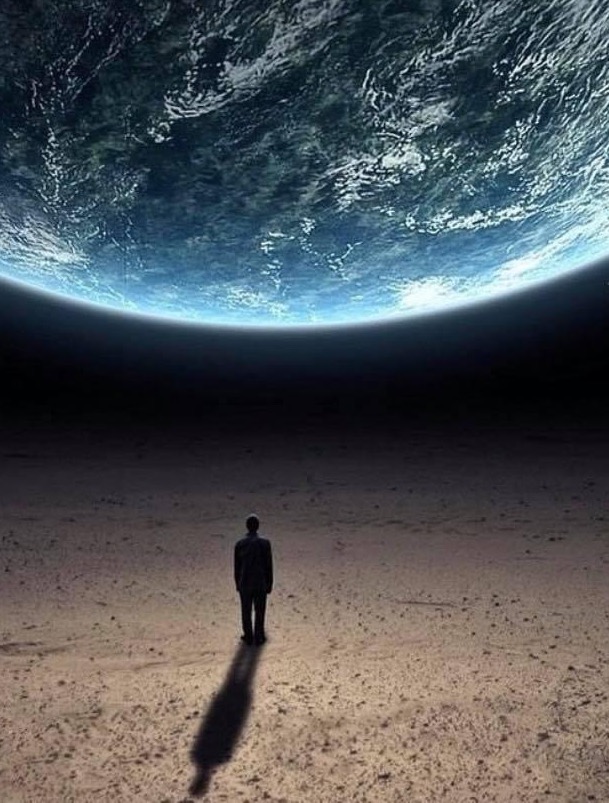
An Exploration into Esoterica, Spiritual Science, Anthroposophy and Human Evolution CONTENTS :) LIBRARY CONTACT Dr. Carl Unger What Is Anthroposophy Feel responsible for every thought, feeling and action. Every moment that we experience in this way brings us forward a little. What would I be without other human beings? Helpless. Streets are paved by others. When I get up in the morning people have already worked for me. My karma is connected with that of other men. I may have been an accomplice to a murderer because I didn't improve him in a previous life. One man's gain is someone else's loss. Teachers taught me. People worked for me from the moment I was born. So do good for all mankind. By Rudolf Steiner Esoteric Lessons Part III: Berlin, 12-21-1904 ...By its very progress, science will increasingly drive conceptions about the supersensible world out of the world of the senses. If human beings failed to take in any supersensible, spiritual concepts, this would eventually exclude them entirely from the spiritual world; they would be condemning themselves to becoming after death totally bound up with the physical earth alone, and with what the physical earth will one day become.
Since
the physical earth will become a corpse in the
future, human beings would thus be facing the
frightful prospect of condemning themselves to
inhabiting a corpse in the guise of its soul if
they failed to decide that they must learn how
to live in the spiritual world and take root
there.... "Secret Brotherhoods and the
Mystery of the Human Double" pg
48-49 By
Rudolf Steiner
Yesterday
we got to the point in our esoteric training where
we place our doppelganger outside us. It's verily
not a pleasant feeling when we see all of what we
previously had in us unconsciously objectively
before us, which then accompanies us wherever we
go. We heard that it's a Luciferic being, Samael,
with his hosts who brings the doppelganger out of
us. From this, one sees that Luciferic beings also
do good things and not always bad ones. If we
always carried our defects in us unconsciously, we
could never become aware of the destructive,
ruinous things that they do in our body and in the
whole cosmic substance. As long as Samael hasn't
brought our defects out from within us, as long as
we don't see them objectively before us as our
doppelganger, so long the Gods graciously keep us
from seeing the ruinous, destructive force of
jealousy, hate, envy and other passions and
emotions that we stream out into our environment.
A clairvoyant sees that these passions tear
something down in our physical body and in the
cosmos' substance, whereas the good stimulates
upbuilding forces. So basically Samael is a
blessing for development. He shows us our inner
nature all the more accurately the more seriously
we take our training in hand. We then see defects
objectively which we hadn't paid any attention to
previously.....
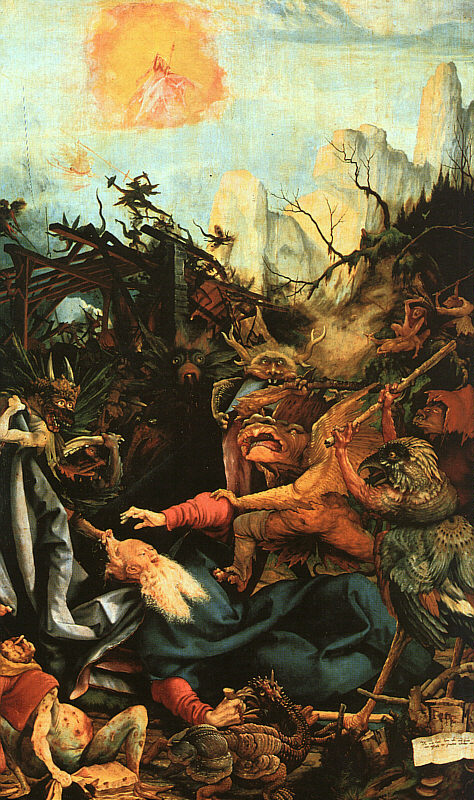
The
Temptation of St. Anthony
|
 Truth can be unpleasant, perhaps even cruel, at times. But modern man has no business to become rickety in soul through following a vague incomplete mysticism. What is required to-day is to penetrate the true mysteries of man's inner nature with all our intellectual powers — with the same powers that we have disciplined in the cause of science and used to effect in the outer world. There is no mistaking what science is. It is respected for the very method and discipline it demands. It is when we have learnt to be scientific that we appreciate the achievements of a vague mysticism at their true worth but we also discover that they are not what spiritual science has to foster. On the contrary, the task of spiritual science is to reveal clearly the true nature of man's being. This in turn makes possible a sound understanding of the outer world. Paths to the Spirit in East and West - Rudolf Steiner
Dornach, 26th January, 1923. In my last lectures, I spoke of man's fall into sin and of an ascent from sin. I spoke of this ascent as something that must arise in the present age from human consciousness in general, as a kind of ideal for man's striving and willing. I have pointed out the more formal aspect of the fall of man, as it appears in the present time, by showing how the fall of man influences intellectual life. What people say concerning the limitations of our knowledge of Nature, really arises from the view that man has no inner strength enabling him to reach the spiritual, and that he must therefore renounce all efforts that might lift him above earthly contemplation. I said that when people speak to-day of the limits of knowledge, this is only the modern intellectual interpretation of how man was cast down into sin; this was felt in older times and particularly during the Middle Ages. To-day I should like to speak more from a material aspect, in order to show that modern humanity cannot reach the goal of the evolution of the earth, if the views acquired in a more recent age — especially in the course of an intellectual development — do not change. Through the consciousness of sin, the general consciousness of to-day has, to a certain extent, suffered this very fall of man. Modern intellectualism already bears the marks of this fall and decay; indeed, the decay is so strong that, unless the intellectual civilisation of the present time changes, there is no hope of attaining mankind's goal in the evolution of the earth. To-day it is necessary to know that in the depths of the human soul forces are living that are, as it were, better than the present state of the consciousness of our civilisation. It is necessary to contemplate quite clearly the nature of the consciousness of our civilisation. Man's Fall and Redemption By Rudolf Steiner |
| Created
5-03-1999 |
| FAIR USE NOTICE: This site contains copyrighted material the use of which has not always been specifically authorized by the copyright owner. We are making such material available in our efforts to advance understanding of spiritual injustice, political, human rights, economic, democracy, scientific, and social justice issues, etc. We believe this constitutes a 'fair use' of any such copyrighted material as provided for in section 107 of the US Copyright Law. In accordance with Title 17 U.S.C. Section 107, the material on this site is distributed without profit to those who have expressed a prior interest in receiving the included information for research and educational purposes. For more information go to: http://www.law.cornell.edu/uscode/17/107.shtml. If you wish to use copyrighted material from this site for purposes of your own that go beyond 'fair use', you must obtain permission from the copyright owner. |